Plan: a V1.0 demo with four spoken commands
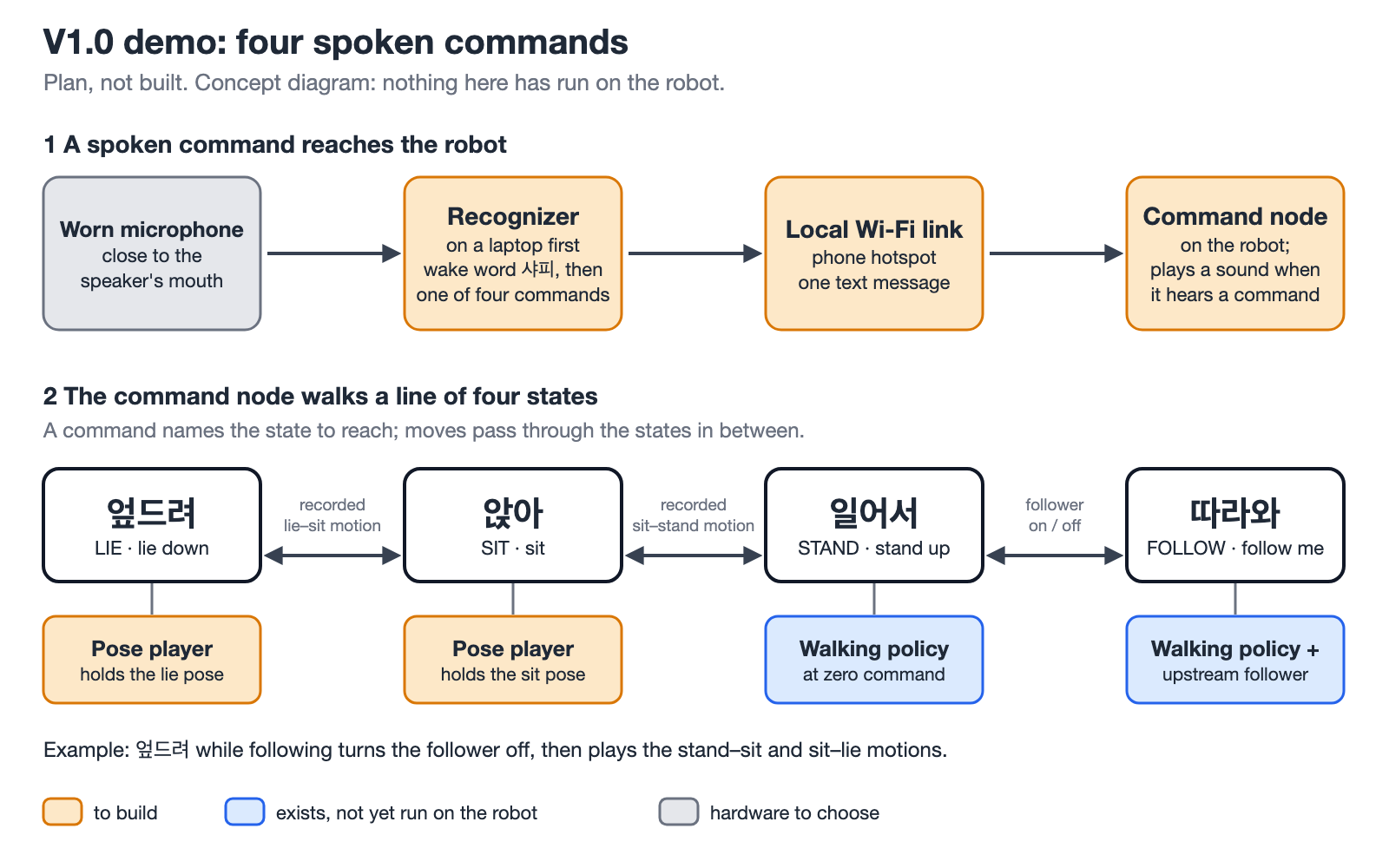
A short demo of Version 1.0 on the president's lawn was proposed, with follow-me as the candidate. The proposed scope is four spoken Korean commands, sit (앉아), stand up (일어서), follow me (따라와) and lie down (엎드려). This is a plan, not a result. Most of the motions already exist upstream or in our simulator, so the new work is a command layer that decides which controller runs, a voice front end, and a series of checks, the first two of which need no robot.
- Command layer: a line of four states, lie, sit, stand and follow. A command names the state to reach and the robot walks the line to it, so lie down while following turns the follower off and then goes through stand and sit. Any posture command ends follow mode, so no stop command is needed; the gamepad's emergency stop stays with the operator
- Sit and lie down: upstream ships recorded joint-angle motions for stand–sit–stand (394 frames, 14 s) and lie–sit–lie (374 frames, 13 s). Its animation controller always plays a file from the first frame to the last, so a pose player of our own plays the lie–sit and sit–stand halves forward and backward and holds the pose in between. The motions have not been played in our simulator or on the robot
- Stand and walk: the commands policy at zero command, with the fall-recovery controller behind it. The pose player and the walking policy hand over only in the standing pose, where the policy's one-second start-up has nothing left to do
- Voice: nothing exists in this repository. The recognizer is proposed to run on a laptop with a worn microphone, which sits close to the speaker's mouth, and to send one text message per command, so the engine can be changed. A wake word (샤피) keeps conversation near the microphone from triggering motions, and the robot answers each accepted command with a sound. No engine has been tried on Korean commands, and a search found no accuracy figure for short Korean commands, so the choice is a measurement
- Follow-me so far, simulation only: the commands policy with upstream's person follower unchanged, three scripted walks of the person at 0.2–0.35 m/s, six runs, no fall and no emergency stop. The robot ended 0.87–0.90 m from the person, who stood still at the end, with a perfect detector and 0.98–1.18 m with YOLOv8m on the simulated fisheye view, and was never more than 2.2 m behind. Nothing has been run on the robot
- What limits follow-me before the robot is tested: upstream's follower steers by the first person in its detection list and does not track identity, so a second person on the lawn can take the lock; its area term caps the forward command near 0.375 m/s, so the person must walk slowly; upstream's camera configuration sets the head camera to 5 frames per second; it stops after 2 s without a detection. None of it has been tried on grass
- Gates, in order, with proposed pass lines. (1) ROS 2 simulator: 10 cycles of every move between the four states, no fall, each ending in the commanded state. (2) Recognizer on recorded speech: 20 utterances of each command from three speakers, 95 % correct in a quiet room and 90 % with wind and footsteps played back, at most one false trigger in 10 minutes of ordinary talk. (3) Robot on a flat floor: the same 10 cycles, then following a person for 10 m five times out of five, with a second person crossing. (4) Lab floor: the full script, sit, stand, follow, sit, lie down, stand, 10 runs with at least 8 clean. (5) Lawn: the same script five times with at least 4 clean; otherwise the demo moves to hard ground
- Gates 1 and 2 need no robot, and the command layer and the recognizer can be built and run against the simulator now. Everything on the robot waits for assembly, bring-up and the first walk; on the Oct 27 roadmap assembly was in progress and the other two were not started
- Open: the demo date, who speaks the commands, the microphone to wear, whether other people stand on the lawn during follow-me, and the speed of the sit and lie-down motions (the recorded halves take about 6 s each)