One policy for walking, commands and fall recovery
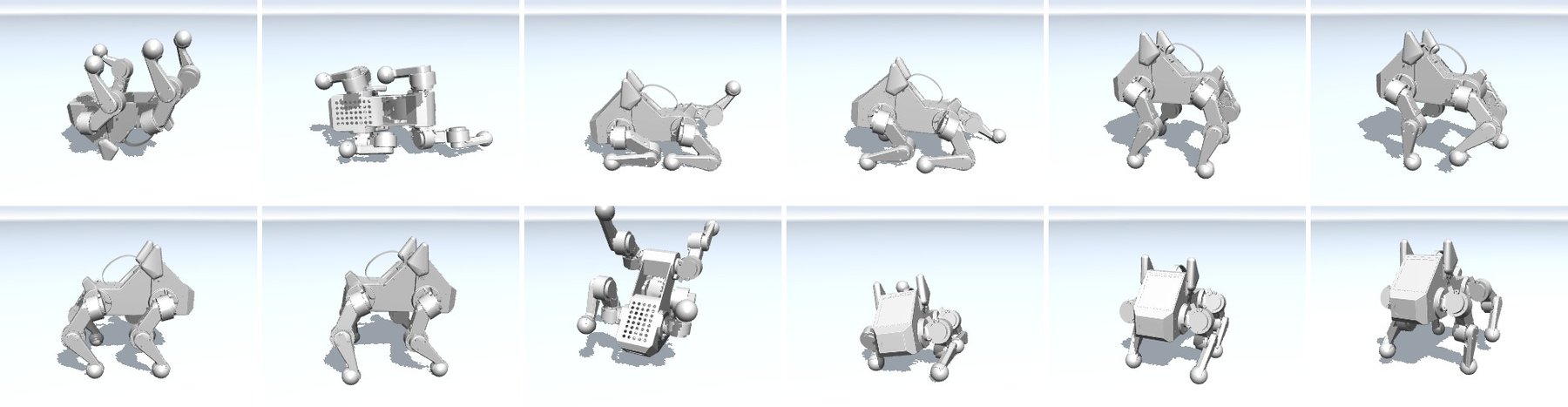
One network now does in simulation what three controllers did together. It walks over the multi-terrain course, follows the behaviour commands, turns the robot over after a fall, stands it up and walks again, with no switch between policies. It was trained to imitate the three (the walking policy with commands, the recovery policy and the walking controller's start-up) on the states it reaches itself. It matches them on all three tests (terrain, commands and fall recovery) in the training simulator, but not yet in the robot's control software.
- Network: the walking policy's size (1024-512-512-512), 46 inputs per step over 20 steps; 43 min of training on the lab PC
- Terrain test course (34 tests, 100 runs each, two seeds): 82.5 % of runs passed on the trained tests against 83.1 % for the walking policy in the same evaluation; held-out tests 85.5 % against 86.1 %
- Commands on flat ground: crouch 14.2 cm at a 13 cm command, swing peak 7.8 cm at 8 cm, 3.98 Hz at 4 Hz; the walking policy 14.1 cm, 7.7 cm, 3.98 Hz
- After a fall, up and walking 0.6 m by 10 s, 800 runs per start (one policy / three controllers): left side 0.95 / 0.94, right side 0.97 / 0.97, back 0.96 / 0.96, nose up 0.98 / 0.98, nose down 0.62 / 0.61, pushed while standing 0.63 / 0.67
- The first run fell short from nose down (0.56 / 0.62 on the same 800 runs). The one change: every update now sees all 10 s of the fall episodes, where it had seen 6 of the 10 seconds, the ones with few flipping states. One run each, so a second seed would tell this change from run-to-run variation
- In the robot's control software (ROS 2 simulation, solid body, motor torque-speed curve, one controller with the tilt stop off), 12 falls: it turns over within 1 s every time, then stands up and walks in 4 of 9 side and back falls and 3 of 3 nose-down falls; the three controllers stand up in all 12. Not caused by the simulator's contact, shape, backlash or latency settings (1 of 5 failed falls stood with them set as in training) nor by the start-up gain (the three controllers at the student's gain: 5 of 5)
- Next: why the one policy's stand-up from the belly breaks in the robot's software; meanwhile the three controllers stay the version for the robot