Fall recovery: turning over from the side and the back
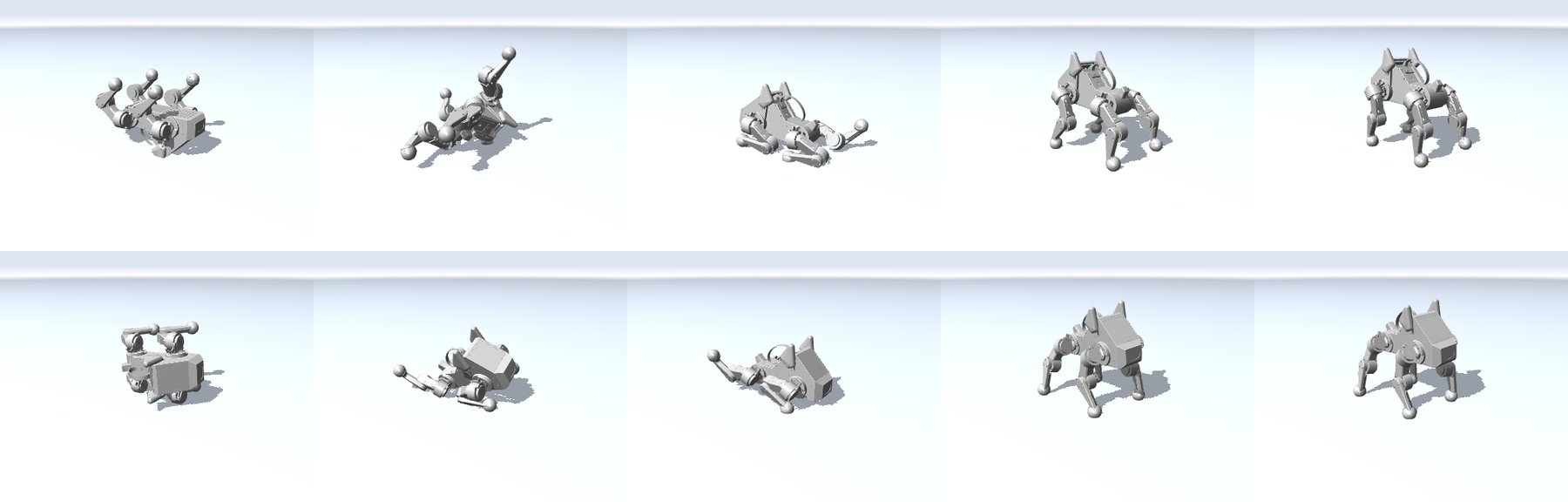
A fallen robot turns itself over and stands up again in simulation. A learned policy flips it onto its belly from its side or back, and the walking controller's own start-up then stands it up. The robot's control software detects the fall from the IMU and switches between the two policies by itself. The body is solid in the final tests, so legs cannot pass through the torso or through each other.
- Flip policy: the walking policy's network size, trained from scratch from random fallen poses (side, back, nose down, mild tilts) in 25 min (400 M steps), with the motor's torque-speed limit; it first flips after about 100 M steps
- 200 trials per start in the solid-body model (stiff contacts between torso and legs): upright at the end in 1.00 from the left and right side, the back, the back rolled 30° each way and nose up, and 0.98–1.00 at 2.4 and 2.0 N·m and friction 0.5 and 1.2. Nose down 0.85, and 0.46–0.66 at the reduced torques. The default pose and the walking policy stay on their back and side
- In the robot's control software (ROS 2 simulation, motor torque-speed curve, solid body), a fall supervisor reading only the IMU, one run per start, seconds after the fall is detected — upright / standing / walking again: left side 0.71 / 1.95 / 3.13, right side 0.83 / 1.67 / 2.56, back 1.55 / 2.38 / 3.24, nose down 2.46 / 3.83 / 4.81; no falls, 0.32–0.50 m walked afterwards
- It ends flat on its belly, torso 0.077 m high; the walking controller's start-up (one second to the default pose) stands that posture up in 12 of 12 end postures, torso 0.152 m. Standing from the belly was never learned by the flip policy itself
- Why the final tests use stiff solid contacts: the first policy, trained with legs and torso able to pass through each other, is upright in 3,200 of 3,200 trials in a body whose solid contacts are soft, but with stiff contacts it turns over from the right side in 0.86 of trials (0.72–0.88 at the reduced torques). A second one, with joint targets kept 0.3 rad from the stops, was upright in 3,200 of 3,200 and passed a front leg through the back leg of the same side in 94 % of its frames; the walking controller could not stand it up from the back
- A third, trained against the solid contacts (stiff pairs), is upright in 3,200 of 3,200 including nose down and ends on two legs, torso about 0.145 m, joints at their limits; the walking controller did not stand it up in any of 4 runs in the robot's software, so the flat-ending policy stays
- Not yet on the robot: running a second controller instance, the walking controller's 1.5 rad tilt stop and the IMU's mounting offset are untested there; the model's surfaces lack cables, camera and Raspberry Pi