Choosing the gait: a walk trained from scratch
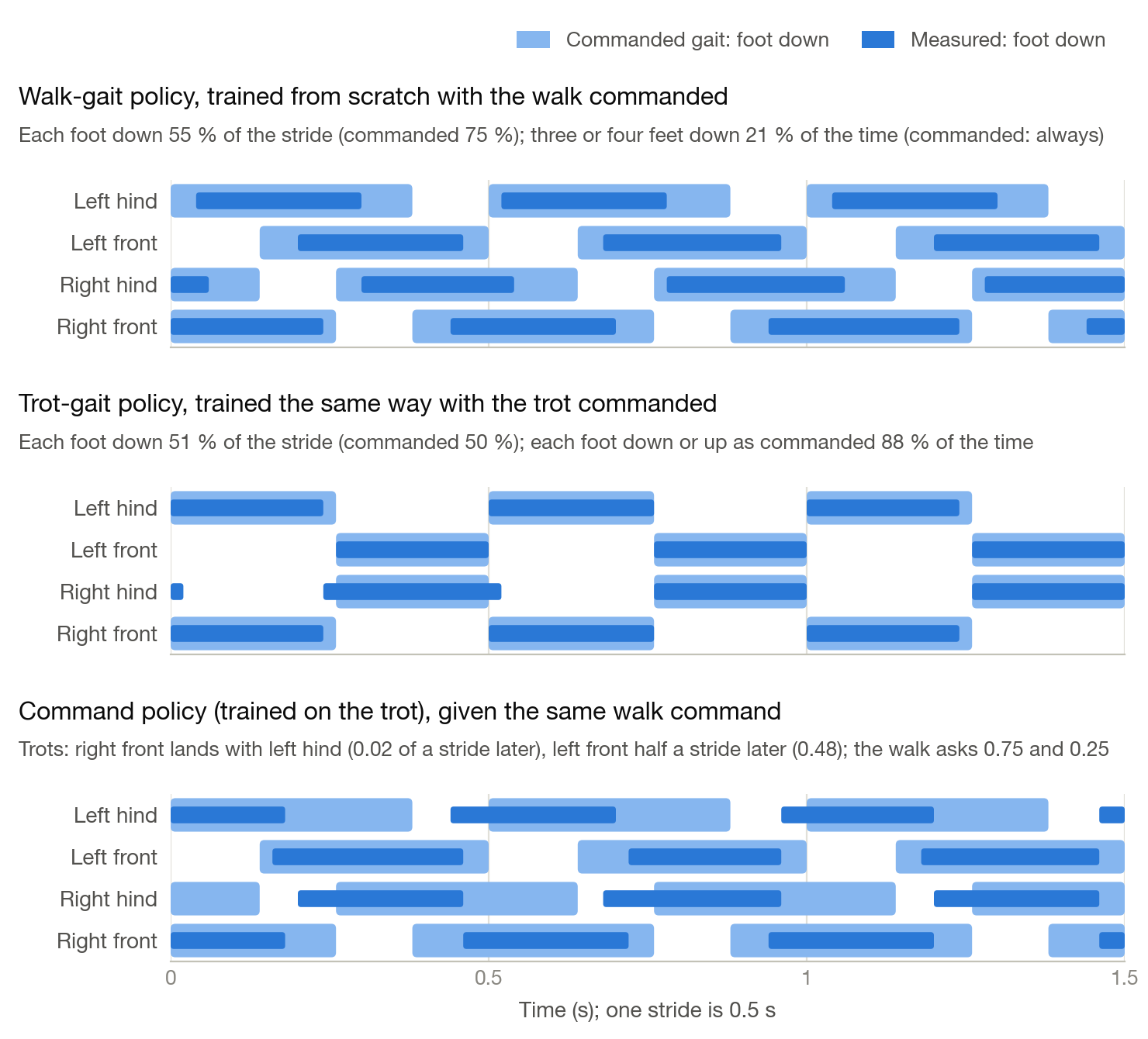
Gait commands had only ever produced the trot. Two policies were therefore trained from random weights, each with one gait commanded from the first step. One was given the walk, the slow gait of dogs, in which the feet land one at a time a quarter stride apart and three feet stay on the ground. The other was given the trot as a control. The walk-gait policy learned the walk's footfall order, which no earlier policy had produced, but not its long stance. Each foot lifts early, so three feet are down a fifth of the time instead of always.
- Setup: 1 B training steps per policy from random weights on flat ground, with the command policy's reward terms and a fixed body height and swing height. The walk was commanded with each foot down 75 % of the stride, the trot with 50 %. Both runs stopped on a GPU memory error late in training, at 953 M and 852 M steps, after their evaluation reward had been flat for 400–500 M steps, so their last checkpoints were evaluated
- Walk-gait policy at 0.3 m/s, 30 walks on flat ground within the robot's joint-target limits: all 30 reached the goal at 2.0 steps per second per leg, as commanded. In 97 % of strides the feet landed in the walk's order (left hind, left front, right hind, right front), 0.32, 0.50 and 0.79 of a stride after the left hind, against the commanded 0.25, 0.50 and 0.75
- Its stance is a trot's: each foot is down 55 % of the stride, against the commanded 75 %, so three or four feet are down 21 % of the time. The line written before the run was 60 %, so by its own criteria the walk was not followed. The footfall order formed between 400 M and 600 M steps, while the stance share stayed at 55–57 % throughout
- Trot-gait policy, same recipe: 29 of 30 walks reached the goal, with diagonal feet in step (0.97 agreement). Each foot was down or up as commanded 88 % of the time, as closely as the earlier command runs that started from a trained policy (0.87). So the recipe works, and the shortfall belongs to the walk and its reward
- Given the same walk command, the command policy keeps trotting: the right front foot lands with the left hind and the left front half a stride later. Neither expert handles the other's gait: under the other gait's command, the walk-gait policy makes no progress in any of 30 walks, and the trot-gait policy crouches to 7.9 cm and makes none either
- Slower walking helps only in part. From 0.3 m/s down to stepping in place, the stance rises from 55 % to 62 % and three feet are down 48 % of the time instead of 20 %. Less foot travel thus explains about a third of the gap at 0.3 m/s, and two thirds remain at zero travel. The command policy does not change across these speeds (stance 51–52 %, three feet down 5–7 %)
- Next: a walk-gait policy trained without the gait clock or a step-frequency command. Its reward asks only that three feet stay planted, and training chooses the step frequency, order and timing. If that run fails, the fallback keeps the clock and adds a reward term that charges a foot for moving while its commanded stance lasts (from Walk These Ways)